Research Themes
Our research program is made up of four interconnected specific objectives, involving the fundamentals and applications of crystal engineering applied to green chemistry and sustainable materials.
Each specific objective is founded upon crystal engineering and organic crystal design approaches pioneered and innovatively advanced by the MacGillivray group. The specific objectives of our research program are to develop, understand, and exploit crystal engineering research in four key areas:
Crystal Engineering for Green Chemistry
Crystal Engineering for Organic Semiconductors and Molecular Solar-Thermal Energy Storage
Crystal Engineering for Innovations in Medicine
Artificial Intelligence & Machine Learning for Accelerated Crystal Engineering
What is Crystal Engineering?
Crystal Engineering is a modern approach to solid-state chemistry, where we exploit our understanding of intermolecular interactions (e.g., hydrogen bonds, -stacking) to control the organization of molecules in crystalline solids.
Effectively, we use these intermolecular interactions to design and build unique crystal structures, which may demonstrate new properties or allow for solid-state chemical reactions that would otherwise be unlikely or impossible in solution. Crystal engineering has led to the formation of multi-component structures composed of various building blocks and has emerged as a powerful approach to control the properties of solids. The modular nature of crystal engineering allows for large compositional variation and provides a means to engineer properties based on the chemical nature and identities of the individual building blocks.
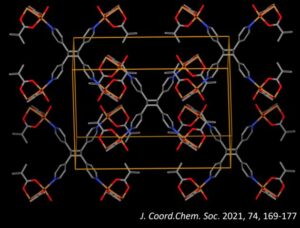
Some key examples of crystal engineering include the development of cocrystals and Metal-Organic Frameworks (MOFs). MOFs are composed of a metal ion and single or multiple organic ligands that generally serve to bridge metal ions in a solid. Cocrystals are crystalline materials composed of two or more different molecular or ionic partner components that are generally in a set ratio that arrange in space to create a unique crystal structure that differs from that of the individual building blocks.
Careful crystal engineering allows us to use noncovalent interactions to obtain specific three-dimensional orientations of building blocks, which is programmed into the system by the crystal packing. This provides us with fine-tuned control over three-dimensional properties, such as optical properties, porosity, magnetic properties, solubility, stability, and conductivity. This fine-tuned control over molecular orientations and alignment also provides a method to reliably guide chemical reactions within the crystal. This allows organic crystals to be used as green chemical laboratories that facilitate the targeted construction of molecules and designer materials.
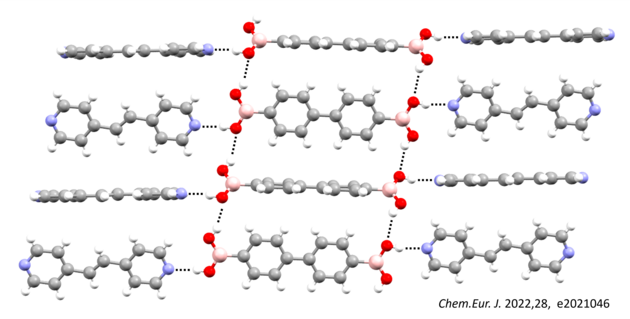
The method to control reactivity within organic crystals is considered green because traditional toxic organic solvents are minimized and generally not required for chemical reactions (solvent-free). Furthermore, the reactions are atom-economical (meaning all reactants are transformed into products) and highly selective (meaning no by-products are formed). The energy used for the reactions is provided by sunlight (ultraviolet light), and the components that guide the reactions are recyclable templates and catalysts (similar to biochemical enzymes). This chemistry is innovative since the geometric information of templates and crystals can create entirely new classes of chemical products, some of which are only just recently discovered naturally (e.g., lipid ladderanes).